
Starbucks’ Strategic Schizophrenia: Can a Pit-Stop Manager Run a Spa?
I recently ran a poll on Facebook to find the “best cafe” in my area.
Out of dozens of local venues, two absolute leaders emerged, with a few others trailing behind. But here is the kicker: Starbucks was not mentioned once. Not a single time.
This is in an area with about a dozen “Iconic Seattle-based coffeehouse” locations. On paper, Starbucks has the most locations, the most data, and the best supply chain. So why, when asked where they truly “belong,” did my neighbours ignore the giant in the room?
The answer isn’t the beans. It’s a phenomenon we call Values Friction.
The Four-Sided Problem: Why Starbucks is Split
Starbucks is currently suffering from “Strategic Schizophrenia.” Under the leadership of Brian Niccol, the company is attempting to be two mutually exclusive things at once: a high-speed Utility Factory and a cozy Third Place Coffeehouse.
As detailed in reports from The Independent, The Wall Street Journal and recent investor updates, this creates four distinct conflicts that are tearing the brand’s identity apart:
1. The 4-Minute Paradox
Niccol has vowed that every order — in-store or drive-thru — will be filled within four minutes. Simultaneously, he has introduced the “Green Apron Service” model, which mandates that baristas make eye contact, smile, and write “meaningful messages” on cups.
- The Clash: In social psychology, a “meaningful connection” requires presence and a lack of rush. By imposing a fast-food stopwatch onto a ritual-based interaction, the company is creating a “psychological pincer” for staff: they must be warm and human while working at a robotic pace.
2. The “Fulfillment Center” vs. “Central Perk” Split
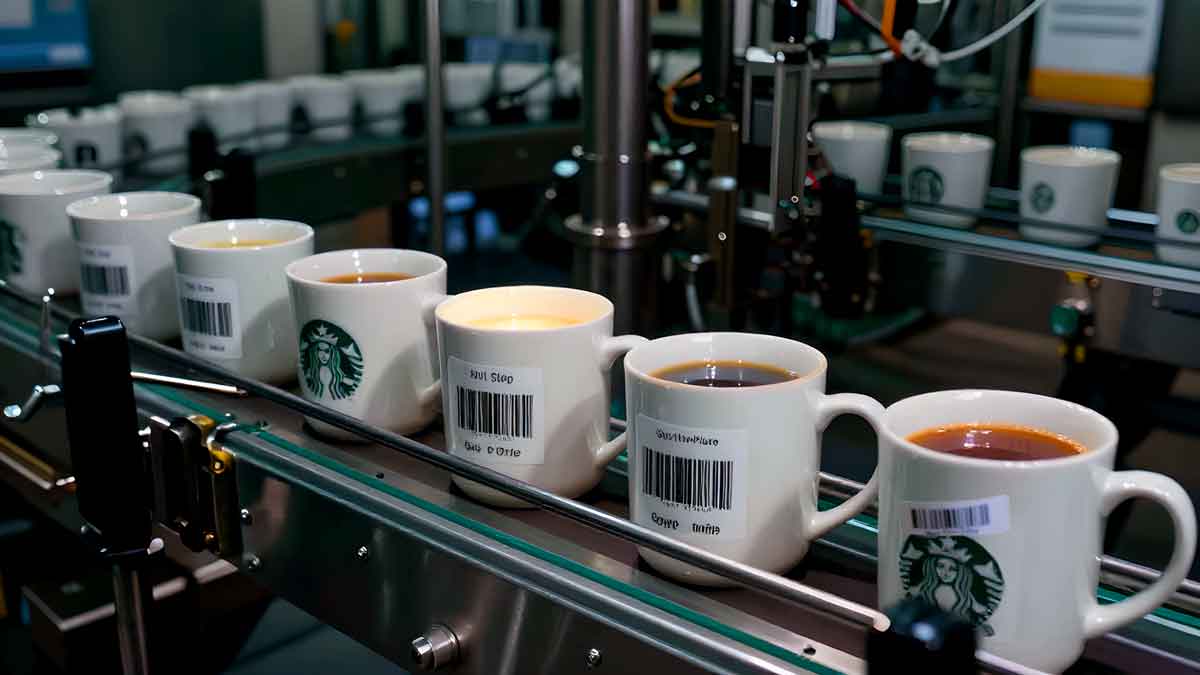
Niccol wants cafes to feel like “community hubs” again, reintroducing ceramic mugs, comfortable seating, and even fixing broken power outlets to invite customers to linger.
- The Reality: Over 70% of transactions are currently mobile, drive-thru, or delivery.
- The “Mosh Pit”: This is the term former CEO Howard Schultz used to describe the peak morning chaos where digital orders collide with in-store guests. By trying to cater to the “grab-and-go” dollars while forcing a “Third Place” vibe, the brand is falling between two chairs.
3. The Leadership DNA Mismatch
Niccol is a “Master Mechanic” of fast food, famous for his turnaround of Chipotle and Taco Bell. Hiring him to revive the “soul” of a coffeehouse is like hiring a world-class pit-stop manager to run a luxury Spa.
- The Bias: Niccol has surrounded himself with a “Chipotle Cabinet” — executives trained in high-volume, high-efficiency operations. While they are excellent at fixing the “leaky bucket” of margins, their professional DNA (and likely their personal value priorities) is often antagonistic to the “slow” values of a neighbourhood cafe.
4. The Labour Crisis: “Equipment Doesn’t Solve the Experience”
In a major pivot from his predecessor, Niccol admitted in May 2025 that “equipment doesn’t solve the customer experience”. He acknowledged that removing labour in favour of automation had backfired.
- The Shift: Starbucks has actually scaled back the rollout of the “Siren Craft System” — a technology designed to automate drink-making — to instead hire more live baristas. However, these baristas are being asked to perform intense “emotional labour,” which union representatives warn is leading to widespread burnout as they struggle to “mean” the connections they are forced to script.
The Science of Value Friction
To understand why Starbucks is failing the “belonging” test in my local poll, we have to look at the Triad of Alignment. For any social space to succeed, three layers must match:
- The Brand Archetype: The “space” the brand claims to occupy (The Neighbour).
- The Staff Values Profile: The intrinsic motivations of the people behind the counter.
- The Regulars’ Profile: The psychological mission of the people in the seats.
At Collectiver, we categorize these missions into four main Archetypes, implemented in the TruvTus tool:
| Archetype | Psychological Mission | Key Motivation |
| The Neighbour | Belonging & Continuity | Regulars want to be known. Staff must value Benevolence. |
| The Professional | Productivity & Results | Regulars want to win. Staff must value Achievement. |
| The Enthusiast | Discovery & Craft | Regulars want to be inspired. Staff must be “coffee geeks”. |
| The Altruist | Connection & Impact | Regulars want to contribute. Staff must value Universalism. |
When these clash, you get Value Friction. If Starbucks hires a “Professional” (Achievement-driven employee) to work at a “Neighbour” cafe, that staff member will naturally prioritize “turning tables.” They are doing a “good job” by corporate standards, but they are effectively destroying the archetype for the regular who wants to linger.
The “Airport Labyrinth” Solution: It’s Not About the Clock
There is a famous story about the Houston airport: passengers complained about long waits for luggage. The airport didn’t speed up the bags; they simply moved the arrival gates further away. By keeping passengers walking (occupied time), the perception of the “wait” vanished.
Satisfaction is based on perception, not just duration. Niccol doesn’t need to hit a 4-minute timer; he needs to make the wait enjoyable. A “Neighbour” regular doesn’t mind a 6-minute wait if they spend that time in a meaningful ritual — which is often the reason they came: the “mingle.” The “Professional” on a mobile app, however, wants a “Just-In-Time” (JIT) experience.
Niccol as the “Values Hub”
This doesn’t mean Niccol is the wrong man for the job. If he has the right personal values profile, he may be the “central values hub” necessary to bridge these worlds. His operational DNA can fix the business’s “leaky bucket,” while his “Back to Starbucks” initiative attempts to protect the brand’s soul.
However, he cannot fix this with a single, “schizophrenic” store model. The only logical solution is to operate three distinct types of Starbucks (at times, literally under the same roof – but with different layout, etc.):
- Starbucks Classic (The Neighbour): The revival of the “Third Place.” With baristas hired for Benevolence, measured by retention and community vibe. No “mosh pits” allowed.
- Starbucks Boutique (The Enthusiast): Focusing on coffee craft and discovery. Hired for Stimulation, measured by product knowledge.
- Starbucks Express (The Professional): Drive-thrus and kiosks. Hired for Achievement, measured by the 4-minute clock and accuracy.
The Lesson for Your Business
The reason Starbucks was invisible in my local poll is that they’ve lost their “Neighbour” soul to their “Professional” operations.
In a service-heavy model, the Staff is the Medium. If you hire for “personality” (attitude) but ignore “motivation,” you will always have friction. A “friendly” person driven by excitement (Enthusiast) will eventually get bored in a quiet neighbourhood shop. A person driven by caring for others (Neighbour) will thrive there for years because their “Home” is making others feel safe.
Niccol’s success won’t depend on how fast he can make a latte. It will depend on whether he can stop the “Strategic Schizophrenia” and start hiring Archetype Guardians who actually match the mission of the specific store they work in.
Are you running a “Pit-Stop” or a “Spa”? Identifying Value Friction is the first step toward high retention and customer loyalty. We have developed TRUVTUS, a lightweight web-based tool designed to diagnose your business’s alignment instantly.
Take the TRUVTUS test today to see if your team’s values are building your brand — or quietly breaking it.