
Case Study: When Leaders Self-Censor, Autocracy Wins

Last Friday, I posted a light-hearted, satirical #TGIF meme on LinkedIn — a classic painting re-imagined as ‘The Nightmare Before Anchorage’ with a one witty caption about the exhaustion of high-stakes leadership.
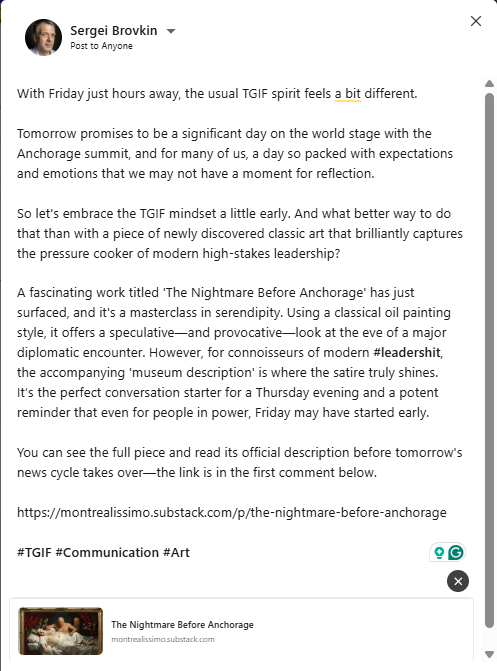
Nothing targeting any person, ethnicity, or group. Within hours LinkedIn permanently deleted it, labelled it ‘hate speech’ and ‘bullying,’ and sent me the usual menacing warning about account restrictions. Born in the USSR, I can spot the warning signs instantly—and silence is one of them.
Born in the USSR, I can spot the warning signs instantly—and silence is one of them.
Some “leaders” avoid discussing major political or social events, telling themselves it’s about “keeping the peace” or “maintaining harmony” in the workplace. In reality, that’s the corporate equivalent of sticking your head in the sand–except in this case, the exposed part eventually gets shot.
I grew up in the Soviet Union, where self-censorship wasn’t just common–it was survival. That’s why I recognize it immediately when I see it creeping into boardrooms and leadership circles today. It’s a dangerous tell, the kind that signals the steady advance of autocracy.
Leaders aren’t meant to live in the swamp, where nothing moves and nothing changes. It might feel safe there, but safety is not the job description for anyone who claims to lead. And when democracy is under pressure–whether in your own country or abroad–silence is not neutrality. It’s complicity.
The Core Issue
This was never about one image. It’s about how corporations outsource judgment to algorithms and cover themselves with vague “community standards” that collapse satire, commentary, and genuine abuse into the same bucket.
That’s not moderation. That’s risk management — of the corporate brand, of personal corporate safety, not the community.
And history tells us what happens when power gets to decide which voices count: the narrowing of discourse, the policing of virtually everything, and the quiet slide from open exchange to managed speech. The Soviet Union did it with censors and informants. Russia does it today with a keyboard and a botnet, and – recently – with hundreds of thousands of wasted souls. Putin seriously referred to the modern Russian political structure he created as a “controlled democracy.” Silicon Valley just wrapped the same instinct in a glossy UX.
Why It Matters
When satire gets flagged as “hate,” the message is clear: don’t challenge, don’t mock, don’t test the edges. Stay bland, stay safe, stay compliant.
That isn’t community safety. That’s corporate power flexing to protect itself, while handing opportunists a ready-made censorship tool — the false flag report.
It starts small: avoid “politically incorrect” humour at work. Do not criticize the National Leader. Say something nice, especially if on air or on TV. Accept bringing in the National Guard “to protect your beautiful city from blood-thirsty criminals.” … And before you know it, you are back in the USSR, whatever you call your country.
See for Yourself
For those curious, here’s a screenshot of the original “offending” post and image. A short, fictional guided museum tour video is now available on YouTube. This magnificent painting will also be on display in the Smythdonian Museum and in COMA.
Final Thought
When freedom of expression collides with corporate liability management and personal career, the art is never the real problem. Nor is the (lack of) sense of humour. The problem is the environment that pretends not to see the difference.
If a piece of satirical art can be labelled both by a “professional platform” as “bullying” and “hate speech” within an hour, the problem isn’t the art. It’s the “professional environment” that can’t tell the difference.
Do not make yourself a part of it.
If you think corporate platforms shouldn’t play thought police over obvious satire, share this post.