
Two Years’ Proof of Concept: What Politics Teaches Us About Productivity
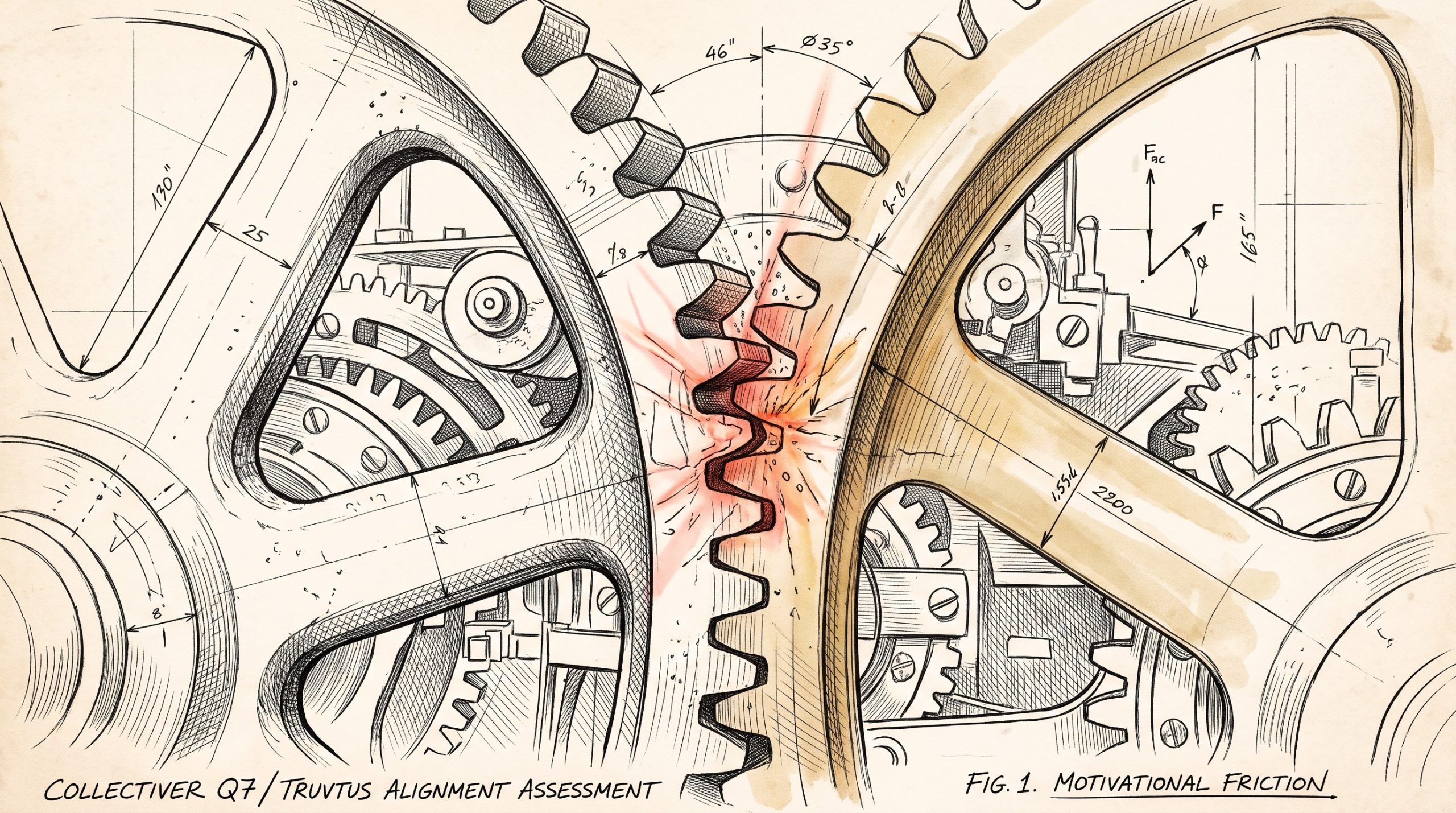
How we accurately mapped the Trump–Musk trajectory—and what it means for executive teams.
Almost two years ago, in late 2024, I posted my take on the post-election situation and made a few specific predictions about the key players, public sentiment, and economic outlook.
Today, watching how things are coming true, I want to revisit this instructive exercise. This is not about politics – not in the usual sense. But because politics, essentially, is the ultimate business, where the actors trade power directly (not through goods and money), the lessons from politics are pertinent in business.
As a management consultant focused on productivity, I look at US politics through an entirely different lens: as the world’s most transparent, high-stakes case study in human behaviour and organizational dynamics.
If my diagnostic framework can accurately anticipate how high-profile leaders will interact under pressure, and how their friction will ripple through organizational output, that framework isn’t just theory. It is a tested proof of concept that you can make work for your business even better than they do in the White House.
The Anatomy of an Inevitable Friction
Back in late 2024, when Donald Trump and Elon Musk were enjoying their political honeymoon, conventional wisdom saw an invincible partnership between political capital and technological disruption.
I looked at the underlying motivational values of the two key figures, applied my tools, and reached a different conclusion: I gave the alliance between six months and two years maximum before a serious disagreement.
Why? Not because of personal animosity, and not because of a specific policy disagreement, for example, over a tax bill. Those are symptoms, not causes.
The real driver was their notable misalignment in core human values.
Using Shalom Schwartz’s framework of basic human values, Musk’s motivational profile is heavily skewed toward Self-Direction and Stimulation—an obsession with autonomy, unconventional problem-solving, rapid iteration, and breaking established boundaries. Trump’s operational profile is anchored in centralized authority, transactional loyalty, and institutional Power and Achievement.
Looking at their profiles (generated by Collectiver Q7 / Truvtus), one can observe two shared values: Power and Self-Direction. This brings their Stars—profile vector, or “common denominator” of sorts—relatively close, suggesting a significant overall alignment of the two profiles (52%). This is a good starting point, no doubt. Especially when both parties share a common objective, feed off each other’s momentum, and assume the other shares their underlying priorities and implicit desires. Honeymoon indeed.
But once you transition from campaigning to governing—or from an executive hiring spree to daily operations—the honeymoon ends. When both individuals are clearly high on Power and Self-Direction, then the power clash is inevitable.
Very close to my prediction, just over six months in, the friction blew open. The subsequent reconciliation we see today isn’t a return to deep partnership; it is an armed truce governed by transactional convenience.
We see this exact dynamic inside companies every day.
A CEO brings in a high-profile “change agent” to disrupt operations, or two firms merge in a high-profile joint venture based entirely on tactical financial synergy. Within twelve months, the initiative stalls, key players quit, and millions are burned. The post-mortem always blames “differing visions” or “style mismatch.”
Now you know that it is not the root cause.
In reality, nobody bothers to gauge the underlying values alignment before signing the contract. Culture didn’t eat strategy for breakfast: the honeymoon was over well before lunch.
Disengagement is an Operational Tax
The second observation from two years ago concerned the broader picture: when leadership relies on vague narratives and promises that pull in opposite directions, the resulting disengagement inevitably drives down the output.
Over the past two years, we watched US GDP growth cool from 3.0% in 2024 to 2.3% in 2025, while labour productivity growth slowed from 3.0% to 2.1%.
Economists will spend endless hours debating interest rate lags, inventory adjustments, and fiscal policy to explain that deceleration. Some others will invoke “previous administration.” Those variables matter, but they miss the root cause: the human engine driving the numbers.
Disengagement is not an abstract polling metric. It is an operational cost.
When people—whether citizens in a nation or employees on a factory floor—feel exhausted by erratic directives and shifting promises, psychological safety evaporates. Engagement disappears. Employees stop proposing creative solutions, start covering their backs, and dig in for self-preservation. In corporate settings, we see this show up as quiet quitting, bureaucratic foot-dragging, and endless alignment meetings that accomplish nothing.
No business can out-process or out-automate an exhausted, skeptical workforce. No “digital transformation” can optimize a bordello. When trust erodes, transaction costs explode, and productivity suffers.
Sustainable productivity requires foundational alignment between purpose, leadership, and the workforce, all of which can be measured systematically.
Measuring What Actually Drives Output
Financial statements tell you where you spent your money yesterday. They do not tell you where interpersonal friction is draining your team’s energy today. You cannot manage an organization or accurately forecast its success purely by looking at lagging financial indicators and formal org charts, especially when internal reporting is skewed to present a better picture.
This is precisely why we developed Truvtus.
By diagnosing the latent values, motivational profiles, and cognitive alignments across leadership teams, Truvtus identifies friction points before they turn into executive turnover, stalled initiatives, or declining productivity metrics.
Truvtus was built on the premise that the “soft” behavioural dynamics inside an organization are actually the hardest variables to fix once they break—and the trickiest to measure. In an average organization, where mutual trust is another contentious issue, that’s nearly impossible.
Truvtus maps these behavioural variables digitally and objectively within minutes.
You don’t have to wait two years for a high-stakes partnership to rupture, or for your quarterly output to cool, before realizing that your leadership team is pulling in four different directions.
The lessons from the political arena are playing out in plain sight—a live demonstration of how unaddressed values friction slows real-world momentum. For business leaders, the takeaway is clear: stop treating alignment as an afterthought. Measure the underlying values before the friction costs you your best people and your quarterly output.
P.S. (Update, October 2026): Just days after this article was posted, Gallup released its latest employee engagement data: U.S. employee engagement fell to 29% in Q3—slipping below 30% for the first time in 15 years.
The main drivers of this decline are unclear expectations and companies pushing tech upgrades while ignoring managerial alignment.
This is exactly the operational tax described above: no software or automation can fix an alienated workforce. Annual surveys only tell you what broke after the damage is done.
If you want to diagnose latent friction before it drags down your operations, check your team’s alignment with Truvtus.